

What does FED stand for in fire safety?

Fire safety is full of acronyms, and FED is one of the more confusing ones because it does not have a single fixed meaning. Search for it and you will find several different answers, which is exactly why so many people end up unsure. If you are a responsible person, a fire warden, or simply the member of staff who got handed the fire folder, knowing what FED means in each context helps you read risk assessments, follow training, and stay on the right side of the law.
In this blog, we explain every common meaning of FED in fire safety, show how the most useful version maps onto your legal duties, and cover the related acronyms (PASS and RACE) that usually come up alongside it.
FED: Fire, Exit, Devices
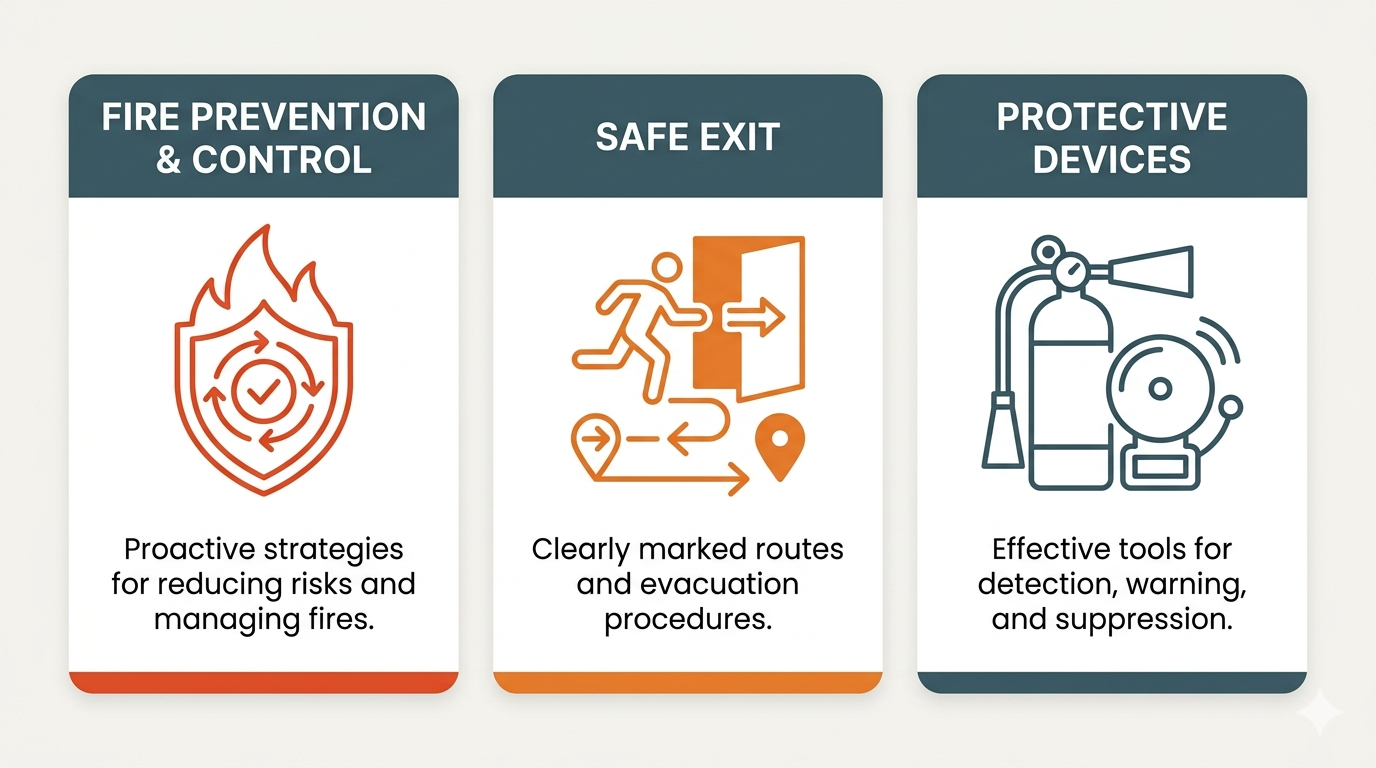
If you only remember one meaning, make it this one. Fire, Exit, Devices is the most widely used version of FED because it neatly captures the three pillars of workplace fire safety. It works as a handy mental checklist for the responsible person, covering prevention, escape, and equipment in a single word. Here is what each letter covers.
- F, Fire: overall fire prevention and control, driven by your fire risk assessment.
- E, Exit: safe, well-planned escape routes so everyone can leave the building quickly.
- D, Devices: the detection, warning and firefighting equipment that protects your premises.
Fire: prevention and control
The “F” stands for the overall job of preventing and controlling fire. How you do this depends on the size and layout of your premises, the number of people on site, and the kind of work being carried out. All of these factors should be captured in your fire risk assessment (FRA), a careful examination of the fire hazards present and what needs to be done to make them safe. Carrying out a suitable and sufficient fire risk assessment is the first and most important duty of the responsible person, and it informs every other fire safety decision you make.
Exit: safe escape
Prevention is the goal, but no workplace is ever entirely risk-free, so the “E” covers safe escape. You need clearly planned escape routes that keep evacuation times short, enough exits for everyone on site including visitors, emergency doors that open easily, and emergency lighting where it is needed, all leading to a safe assembly point outside. Staff need to know these routes and practise them, which leads neatly into one of the other meanings of FED below.
Devices: detection and firefighting equipment
The “D” covers the equipment that protects your building, which falls into 2 groups. Active measures are the ones people picture first, things like fire alarms, sprinklers and extinguishers that actively warn people or help put a fire out. Passive measures are built into the building to slow the spread of fire and smoke, such as fire doors and fire stopping that seals gaps between compartments. Your fire risk assessment determines the right mix, and all of it needs regular inspection and maintenance to be reliable in an emergency.
Why this version matter most
Fire, Exit, Devices is more than a memory aid. It mirrors the structure of your legal duties: assess and prevent fire, guarantee safe escape, and provide and maintain the right equipment. Get those three right and you have the backbone of a compliant fire safety strategy.
The other meanings of FED
Because FED is an informal acronym rather than an official term, different trainers and professionals use it in different ways. Here are the other meanings you are likely to come across, and when each one applies.
Fire Evacuation Drill
FED is often used as shorthand for a Fire Evacuation Drill, a practised walkthrough of your escape plan. In most UK workplaces a fire drill should be carried out at least once a year, though more frequent drills are safer and are expected in higher-risk settings such as care homes. Drills familiarise people with the alarm and escape routes so they react calmly rather than panicking, and they give you a chance to spot and fix problems before a real emergency. Always record each drill, including how long the evacuation took and any issues, as part of your fire safety documentation.
Fire Extinguisher Device
FED can also mean Fire Extinguisher Device. Adding the word “device” simply makes it clear you are talking about a handheld extinguisher rather than other firefighting equipment such as hose reels. Extinguishers are colour-coded and classified by the type of fire they tackle, they must be present and accessible in the workplace, and while anyone may use one in a genuine emergency, nominated staff should be trained so they can act effectively and safely.
Fire Extinguisher Demonstration
In a training context, FED sometimes refers to a Fire Extinguisher Demonstration, a hands-on session where people practise using extinguishers on a controlled fire. Some trainers even use FED as a mini-acronym for the steps involved: Familiarise (check the extinguisher suits the fire), Execute (follow the PASS technique, covered below), and Discharge (operate the extinguisher safely on the fire). Practical sessions like these are at the heart of our practical fire safety training, where staff get to use real extinguishers under expert supervision.
Flat Entrance Door
In residential fire safety, FED stands for Flat Entrance Door. These are the fire-rated doors to individual flats in shared residential buildings, and they play a critical role in containing fire and smoke. Following the Fire Safety (England) Regulations 2022, which came into force in January 2023 in response to the Grenfell Tower tragedy, those responsible for shared residential blocks must carry out regular checks of flat entrance doors, typically quarterly for higher buildings, to make sure they still perform as designed.
Fractional Effective Dose
The most technical meaning, Fractional Effective Dose, comes from fire engineering. It is a calculation used to estimate how exposure to the toxic products of a fire, such as carbon monoxide, hydrogen cyanide and reduced oxygen, affects a person over time. An FED value of 1.0 represents the dose at which an average person would likely be incapacitated and unable to escape. Engineers use FED modelling to design smoke control systems, plan evacuation routes and set safe escape times in performance-based fire safety design. You are unlikely to use this version day to day, but it is worth recognising if you see it in a fire engineer’s report.
Every meaning of FED at a glance
|
FED meaning |
Where you will see it |
In short |
|
Fire, Exit, Devices |
General workplace fire safety | The three pillars: prevention, escape and equipment |
| Fire Evacuation Drill | Training & emergency planning |
A practised run-through of your escape plan |
|
Fire Extinguisher Device |
Equipment & risk assessments |
A handheld portable fire extinguisher |
| Fire Extinguisher Demonstration | Practical training sessions |
Hands-on practice using an extinguisher |
|
Flat Entrance Door |
Residential / high-rise safety |
Fire-rated doors to individual flats |
| Fractional Effective Dose | Fire engineering & modelling |
A measure of toxic gas exposure during a fire |
How FED relates to UK fire safety law
The Fire, Exit, Devices version of FED is useful precisely because it lines up with the law. Under the Regulatory Reform (Fire Safety) Order 2005, every workplace must have a responsible person, usually the owner, employer or occupier, who is accountable for fire safety. That person’s core duties map almost exactly onto FED:
- Fire: carry out and regularly review a fire risk assessment, and take steps to prevent and control fire.
- Exit: provide and maintain safe means of escape, and make sure staff know and practise the evacuation plan.
- Devices: provide and maintain appropriate fire detection, warning and firefighting equipment.
If you employ five or more people, your fire risk assessment must be recorded. Fire safety training is also a legal expectation: all staff should receive it at induction and then periodically, usually once a year, with additional training for anyone given a specific role such as a fire warden or fire marshal. Our fire warden and fire marshal training is designed exactly for those nominated people.
Turn FED into confident, compliant staff
Franklin’s Training has delivered fire safety training across the UK for over 20 years, led by ex-fire service professionals. From practical extinguisher sessions to fire warden courses, we help you meet your duties and keep people safe.
Related fire safety acronyms: PASS and RACE
FED rarely turns up on its own. Two other acronyms are taught alongside it, and together they cover how to use an extinguisher and how to respond to a fire.
PASS: how to use a fire extinguisher
- P, Pull the safety pin.
- A, Aim the nozzle at the base of the fire.
- S, Squeeze the handle slowly.
- S, Sweep from side to side across the base of the fire.
RACE: how to respond to a fire
- R, Rescue / Remove anyone in immediate danger.
- A, Alarm / Alert by raising the alarm and calling 999.
- C, Confine / Contain the fire by closing doors and windows if it is safe.
- E, Extinguish / Evacuate, only tackling a small fire if it is safe to do so, otherwise evacuate.
Frequently asked questions
What does FED stand for in fire safety?
FED has several meanings. The most common is Fire, Exit, Devices, a reminder of the three core areas of fire protection. It can also mean Fire Evacuation Drill, Fire Extinguisher Device, Fire Extinguisher Demonstration, Flat Entrance Door, and Fractional Effective Dose in fire engineering.
What is the most common meaning of FED?
Fire, Exit, Devices. It is a handy reminder of your three essential duties: preventing and controlling fire, ensuring safe escape, and maintaining the right firefighting and detection equipment.
What does FED mean in fire engineering?
Fractional Effective Dose. It is a calculation used to estimate how exposure to toxic gases such as carbon monoxide affects a person’s ability to escape during a fire. An FED value of 1.0 represents the dose at which a person would likely be incapacitated.
Is FED an official fire safety term?
Not as a single term. It is an informal memory aid used in different ways by trainers and professionals, except for Fractional Effective Dose, which is a recognised technical term in fire engineering. Always check the context to be sure which meaning applies.
How does FED relate to fire safety law?
The Fire, Exit, Devices version maps onto your duties under the Regulatory Reform (Fire Safety) Order 2005. The responsible person must carry out a fire risk assessment, plan safe escape routes, and provide and maintain suitable fire safety equipment.
What other fire safety acronyms should I know?
Two of the most useful are PASS (Pull, Aim, Squeeze, Sweep) for operating a fire extinguisher, and RACE (Rescue, Alarm, Confine, Extinguish) for responding to a fire. Both are commonly taught alongside FED.
Related Fire Safety Training at Franklin’s Training
Contact Us
For any information on our courses, please fill out the form to the right or call us on the number below.