

What does DRABC mean in First Aid?
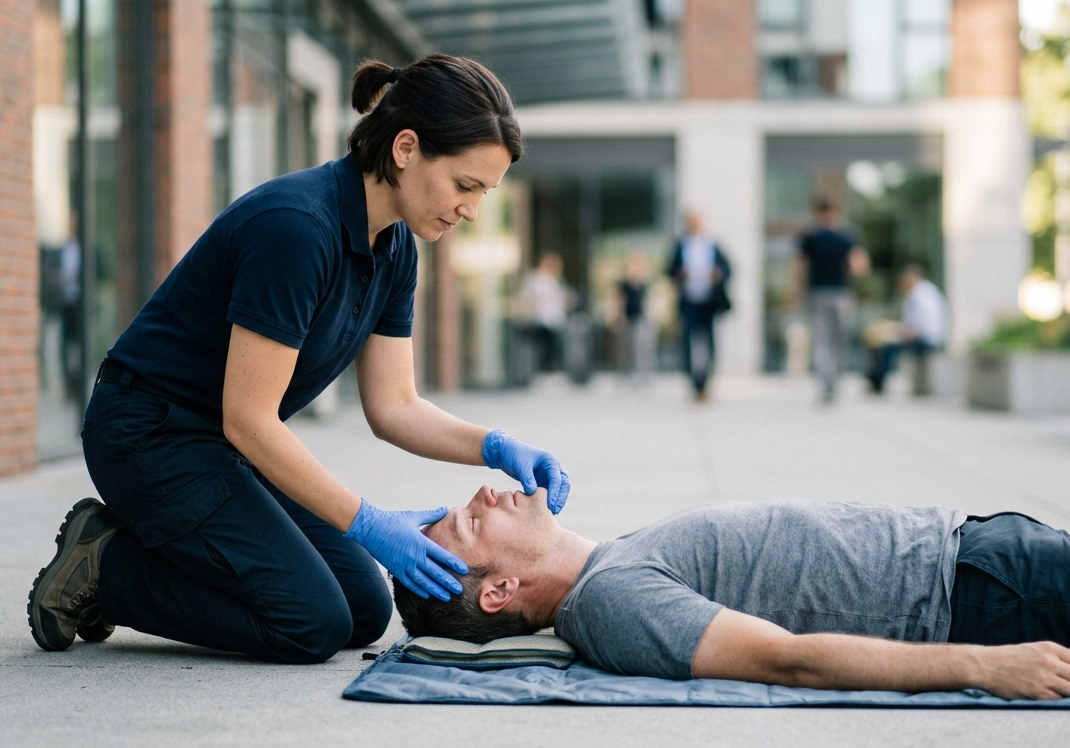
If someone collapsed in front of you right now, would you know what to do first? It is a question most people would rather not think about, yet emergencies rarely give us warning. The good news is that first aiders are taught a short, memorable acronym that takes the panic out of those first few seconds: DRABC. It turns a frightening, chaotic moment into a clear sequence of steps, and knowing it could genuinely help you save a life.
In this guide, we explain exactly what DRABC means in first aid, walk through each step in plain English, show how it compares with related acronyms such as DRSABCD and ABC, and cover the important 2025 update that has seen DRABC evolve into DR C ABCDE on many courses.
What does DRABC stand for?
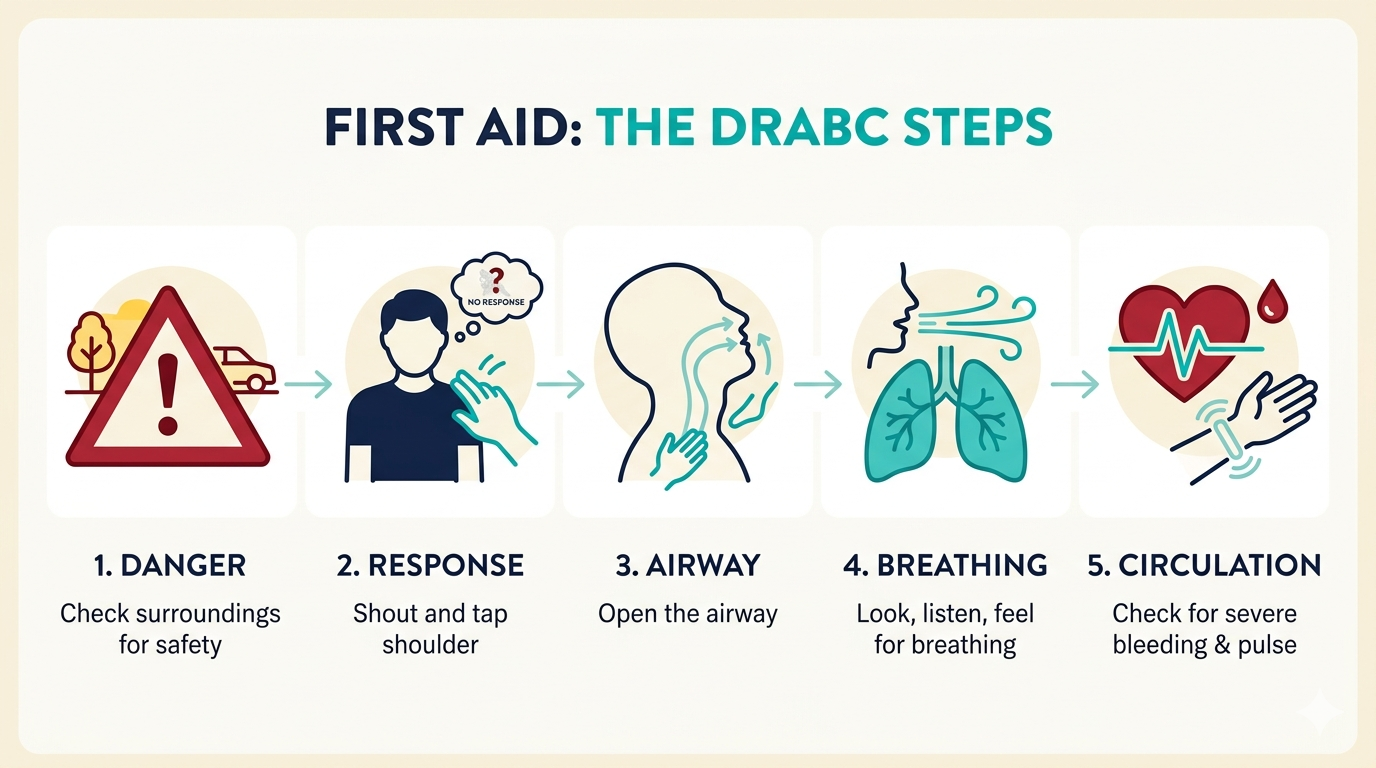
DRABC, also written as DR ABC, is an acronym where each letter prompts a check or an action. Worked through in order, the five steps make sure you protect yourself first and then deal with the casualty’s most serious problems before less urgent ones:
-
D – Danger:
Check the scene is safe for you, the casualty and any bystanders before you approach.
-
R – Response:
Find out whether the casualty is conscious by talking to them and gently tapping their shoulders.
-
A – Airway:
Open the airway using a head-tilt, chin-lift so the casualty can breathe.
-
B – Breathing:
Look, listen and feel normal breathing for up to 10 seconds.
-
C – Circulation:
Check for severe bleeding and signs of life. If the casualty is not breathing, start CPR.
DRABC is one of the first things you learn on any accredited first aid course, and for good reason. It gives even a complete beginner a reliable framework to fall back on when the pressure is on.
Why is DRABC so important?
Emergencies are chaotic and stressful. Adrenaline makes it tempting to rush straight in, but rushing is exactly how well-meaning helpers get hurt or miss something critical. DRABC brings order to the chaos.
By following the steps in sequence you make sure you:
- Protect yourself and others from further harm before doing anything else.
- Find life-threatening problems quickly, because the steps are ordered by what will kill a casualty soonest.
- Deliver the right care in the right order, rather than getting distracted by an obvious but less serious injury.
Skipping steps or doing them out of order can make a situation worse. Practised properly, DRABC keeps you focused and effective even when everyone around you is losing their head.
The five DRABC steps explained
Step 1 – Danger
Before you start, stop and look around. Is it safe to approach. A first responder who becomes a second casualty cannot help anyone, and only adds to the burden on the emergency services when they arrive. Common hazards to scan for include:
- Oncoming traffic
- Fire, smoke or chemicals
- Live electricity
- Broken glass, sharp objects or unstable structures
If the scene is not safe, do not enter. Remove the danger if you safely can, or call 999 and wait for professional help. Only once you are confident it is safe should you approach the casualty.
Step 2 – Response
Next, find out whether the casualty is conscious. Kneel beside them, speak loudly and clearly: Can you hear me? Open your eyes!, and gently tap or squeeze their shoulders. A response, whether speech, movement or eye-opening, tells you a great deal about how serious things are. No response means you need to act quickly and move on through the steps. Many first aiders use the AVPU scale here, which we explain below.
Step 3 – Airway
If the casualty is unresponsive, their airway may be blocked, commonly by the tongue falling back when the muscles relax. Open the airway using the head-tilt, chin-lift technique: place one hand on the forehead and gently tilt the head back, then lift the chin with two fingertips. If you can clearly see an obstruction in the mouth, remove it carefully, but never go blindly fishing around. A clear airway is essential; without it, nothing else you do can work.
Step 4 – Breathing
With the airway open, check for normal breathing for no more than 10 seconds. Look for the chest rising and falling, listen for breath sounds, and feel for air on your cheek. Be careful not to mistake occasional gasping (known as agonal breathing) for normal breathing, it is not, and it is a sign the casualty needs CPR. If they are breathing normally and there is no sign of serious injury, place them in the recovery position. If they are not breathing normally, move immediately to the next step.
Step 5 – Circulation
The final step focuses on circulation. If the casualty is not breathing normally, call 999 or 112 (or get a bystander to) and begin CPR straight away, for an adult that is 30 chest compressions followed by 2 rescue breaths, repeated until help arrives or the casualty shows signs of life. If a defibrillator (AED) is nearby, send someone to fetch it. Circulation also means checking for and controlling severe bleeding by applying firm, direct pressure to the wound. Learning compressions and safe AED use is at the heart of any Basic Life Support course.
Just to remind you, reading about CPR is not the same as being able to perform it under pressure. Hands-on, instructor-led practice on a manikin is the only way to build the muscle memory and confidence that count in a real emergency.
Checking response: the AVPU scale
To assess response more precisely during the R step, first aiders often use the AVPU scale. It gives you a quick, consistent way to grade how alert a casualty is:
-
A – Alert:
The casualty is awake, eyes open and aware of their surroundings.
-
V – Voice:
They respond only when you speak to them.
-
P – Pain:
They respond only to a gentle physical stimulus, such as a shoulder squeeze.
-
U – Unresponsive:
No response at all, act fast and continue through the airway and breathing checks.
You may also see the newer ACVPU scale, which adds C for new Confusion, reflecting more recent clinical guidance.
When do you put on PPE in DRABC?
A question that comes up often: where does personal protective equipment (PPE) such as gloves and a face shield fit in? The answer is the Danger (D) stage. That step is all about safety, and protecting yourself from infection or contact with bodily fluids is part of staying safe. Putting PPE on before you make contact also gives you a brief, calming moment to prepare for what comes next. If you have no PPE to hand, still carry out your checks but take extra care to avoid contact with bodily fluids and wash your hands thoroughly afterwards.
DRABC, DRSABCD, ABC and ABCD: what is the difference?
DRABC is the foundation, but you will hear several related acronyms. They are all built around the same core idea, assess safety and response, then work through airway, breathing and circulation, with extra letters added depending on the setting and level of training.
|
ACRONYM |
STEPS INCLUDED | BEST THOUGHT OF AS |
|
ABC |
Airway, Breathing, Circulation | The three core life-saving checks at the heart of every version |
|
ABCD |
Airway, Breathing, Circulation, Defibrillation | The core checks plus using an AED |
| DRABC | Danger, Response, Airway, Breathing, Circulation |
The standard UK primary survey |
| DRSABCD | Danger, Response, Send for help, Airway, Breathing, CPR, Defibrillation |
DRABC with calling for help and defibrillation made explicit |
| DR C ABCDE | Danger, Response, Catastrophic bleeding, Airway, Breathing, Circulation, Disability, Exposure |
The updated 2025 approach (see below) |
The main difference between DRABC and DRSABCD is that DRSABCD spells out two things that DRABC leaves implied: S for Send for help early, and a final D for Defibrillation using an AED. Both lead you to the same place; DRSABCD simply makes those critical actions impossible to forget.
The 2025 update: from DR ABC to DR C ABCDE
First aid guidance is reviewed regularly so that it reflects the latest evidence. Following the Resuscitation Council UK 2025 guidelines, many UK first aid courses now teach an expanded version of the primary survey: DR C ABCDE. This does not mean DRABC was ever wrong, the update simply helps first aiders respond earlier, faster and more thoroughly. The three big changes are:
- Call 999 earlier. Rather than waiting until after the breathing check, you now call the emergency services as soon as you find the casualty is unresponsive, ideally putting the phone on speaker so the call handler can guide you while you carry out your checks.
- Catastrophic bleeding comes first. A new C is added between Response and Airway. Life-threatening bleeding – spurting, pouring or heavy uncontrolled blood loss – can kill within minutes, so it is now controlled with direct pressure or a tourniquet before moving on to airway and breathing.
- A more complete assessment. Two further checks are added at the end: D for Disability (signs of stroke, head injury or other neurological problems) and E for Exposure (checking for hidden injuries such as burns or rashes, and keeping the casualty warm).
Put together, the updated sequence reads as Danger, Response, Catastrophic bleeding, Airway, Breathing, Circulation, Disability, Exposure. If you trained a few years ago, the DRABC you learned is still a sound foundation, but it is well worth refreshing your certificate so you are working to the current approach. You will see DR C ABCDE increasingly used in course manuals, with more emphasis on bleeding control and early emergency calls.
Learn DRABC properly?
Franklins Training has delivered accredited first aid training across the UK for almost 20 years. Build the confidence to act when it matters with practical, instructor-led courses taught to current guidelines.
Common mistakes when using DRABC
Rushing in without checking for danger. The most common, and most dangerous, error. You cannot help if you become a casualty too.
Skipping steps. Each letter is there for a reason. Work through them in order rather than jumping ahead to an obvious injury.
Mistaking agonal gasps for breathing. Occasional, irregular gasping is not normal breathing, treat it as a cardiac arrest and start CPR.
Calling for help too late. Under current guidance, call 999 as soon as the casualty is unresponsive. If in doubt, call.
Poor airway management. If the airway is not open, nothing else you do can work.
How to remember DRABC
The acronym is designed to be sticky, but a few habits help it become second nature:
- Repeat the letters out loud until the order feels automatic.
- Run through realistic scenarios with colleagues, friends or family.
- Take a refresher course regularly rather than letting your skills fade.
Workplace first aid certificates are valid for three years, but the HSE strongly recommends an annual refresher in between. If you are an employer, our short guide to the first aiders your workplace needs is a useful starting point for working out your requirements.
Frequently asked questions
-
What does DRABC stand for in first aid?
DRABC stands for Danger, Response, Airway, Breathing and Circulation. It is the primary survey first aiders use to assess a casualty and deal with life-threatening problems in the correct order.
-
Why is checking for Danger the first step?
Because you cannot help anyone if you become a casualty yourself. Checking for hazards such as traffic, fire, electricity or chemicals protects you, the casualty and any bystanders.
-
What is the difference between DRABC and DRSABCD?
DRSABCD adds two steps to DRABC: S for Send for help and a final D for Defibrillation using an AED. DRABC is the core primary survey; DRSABCD simply makes calling for help and early defibrillation explicit.
-
Has DRABC changed in 2025?
Yes. Following the Resuscitation Council UK 2025 guidelines, many courses now teach DR C ABCDE. This brings in earlier 999 calls, control of catastrophic bleeding before airway and breathing, and added Disability and Exposure checks.
-
What should I do if the casualty is not breathing?
Call 999 or 112 immediately and start CPR. If an AED is available, send someone to fetch it and use it as soon as possible.
-
How often should I refresh my first aid training?
Regulated workplace first aid certificates last three years. The HSE strongly recommends annual refresher training in between to keep your skills and confidence sharp.
Related First Aid Training at Franklins Training
Contact Us
For any information on our courses, please fill out the form to the right or call us on the number below.